
Private label product categories: which ones actually work
Why private label works in some categories and not others, what decides it, and what coffee, jewellery, supplements and cosmetics each demand before the first unit.
9 min read
Neofulfill does not manufacture. We find and qualify factories, coordinate samples and production, inspect before shipment and ship the goods. Everything below describes what a category demands of whoever makes it, not something we make ourselves.
Most articles on private label categories are a list: cosmetics, supplements, coffee, apparel, pet products. The list is correct and almost useless, because it does not say what separates a category you can start in a month from one that will take a year.
One thing separates them, and it is not margin or demand.
The question that sorts every category
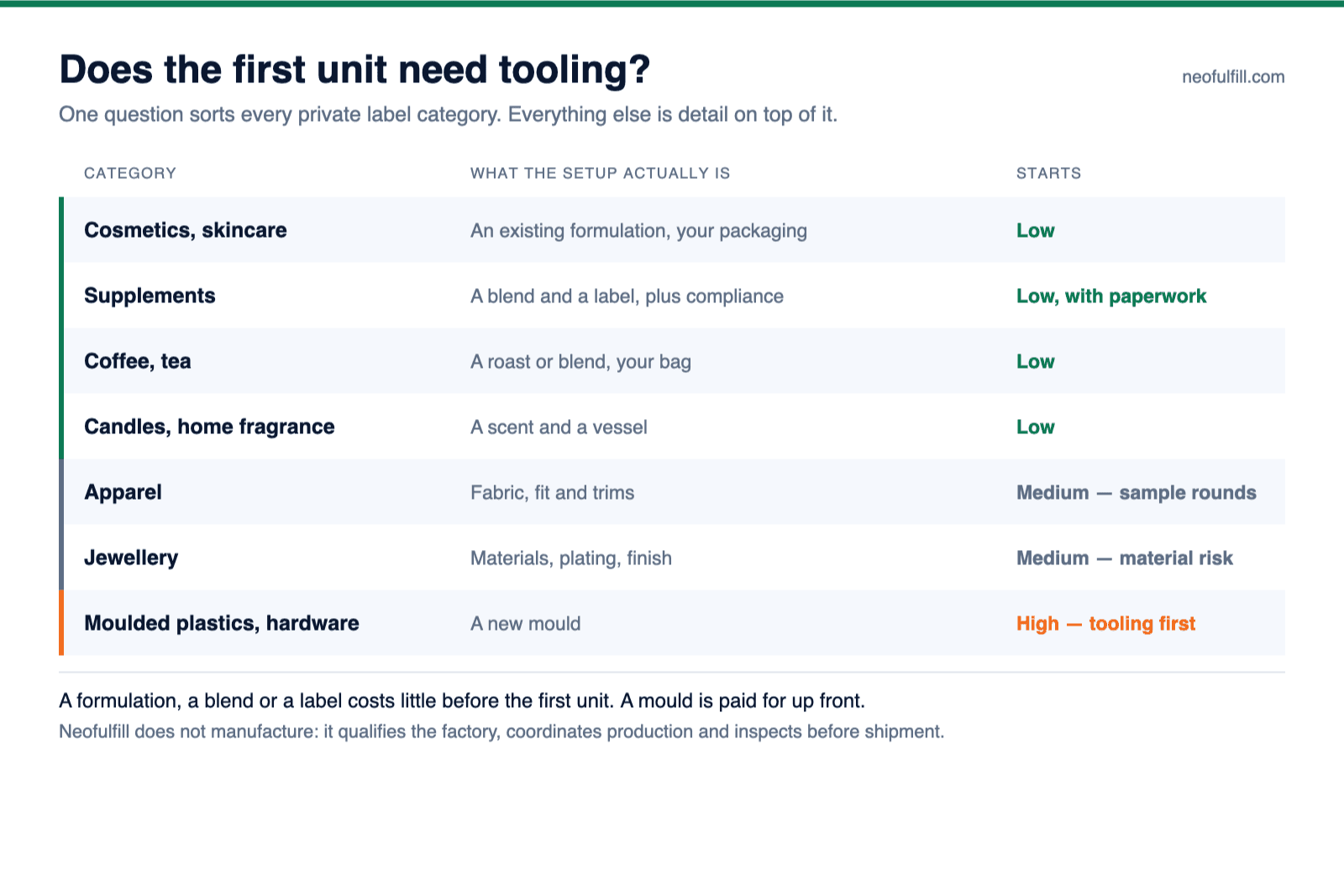
Does the first unit need tooling?
If the setup is a formulation, a blend, a finish or a label, the cost is low and the timeline is short — nobody has to cut steel before anything exists. If it needs a new mould, a last or a die, you are paying a fixed cost up front and amortising it across a run, and the arithmetic changes completely.
That is the whole sorting rule. Everything else is detail on top of it.
| Category | What the setup actually is | Starts |
|---|---|---|
| Cosmetics, skincare | An existing formulation, your packaging | Low |
| Supplements | A blend and a label, plus compliance | Low, with paperwork |
| Coffee, tea | A roast or blend, your bag | Low |
| Candles, home fragrance | A scent and a vessel | Low |
| Apparel | Fabric, fit and trims | Medium, several sample rounds |
| Jewellery | Materials, plating, finish | Medium, material risk |
| Moulded plastics, hardware | A new mould | High, tooling first |
Coffee: easy to brand, awkward to hold
Roasters packing under someone else's brand is ordinary, which is why private label coffee dropshipping looks like one of the softest entries available. The branding side genuinely is.
What catches people is the product itself. Coffee is at its best within weeks of roasting, so stock sitting a long way from the customer is working against the thing you are selling. The model that suits coffee is small, frequent runs close to the buyer, not a container held for a quarter.
Decide the shelf-life question before the packaging question. It is the one that determines whether the business works.
Jewellery: the category where materials are the risk
Jewellery starts low because the setup is finish and plating rather than tooling, and the margins are attractive for the same reason the risks are.
Three questions to any dropshipping jewelry supplier, in this order: what is the base metal, what is the plating thickness in microns, and has it been tested for the market you sell into. Materials in jewellery carry genuine regulatory exposure in most Western markets, and a supplier who cannot answer the second question has already answered the third.
Plating thickness is also where returns come from. A piece that discolours in a fortnight generates a refund and a review, and the difference between that and a piece that lasts is a number the supplier knows and will tell you if asked.
Cosmetics and supplements: cheap to start, expensive to get wrong
Both start from an existing formulation with your branding on it, so the entry cost is among the lowest available. Both also carry compliance that is per market and per variant, and that is not optional.
The pattern to avoid is funding certification from scratch. Where a formulation already ships into your market, the compliance work exists; where it does not, you are paying for it and waiting on it. Ask who already exports this exact product to where you sell, and let the answer steer the shortlist.
Apparel: not hard, but long
Apparel has no tooling, so it reads as a low-cost entry. The cost is in time instead: fabric is bought before the garment exists, minimums are usually per colourway rather than per style, and fit is developed over several sample rounds.
Three colours of one shirt can therefore be three minimums, not one. What an apparel sourcing agent actually does sets out the sample ladder and why compressing it is the most expensive saving available.
The categories worth avoiding first
- Anything needing a new mould. Viable, but it is a tooling project, not a private label project, and it should be budgeted as one.
- Anything with heavy certification you would fund from scratch. Electrical goods, anything for children, anything medical.
- Anything where shipping costs more than the product. Bulky and cheap is the combination that quietly kills the margin.
- A category you do not already sell in. Private label suits a SKU with sales history. It is the wrong instrument for finding out whether something sells.
What to settle before choosing
Four questions, in order. They apply to every category on this page.
- What sets the minimum — the factory, or the material supplier behind it?
- Is there tooling, and who owns it when the relationship ends?
- What compliance already exists for this product in my market, and who holds it?
- What does inspection produce — a measurement sheet against an approved sample, or an opinion?
What private label costs to switch to covers the four costs that land before the first sale, and private label manufacturers in China maps minimums by category.
Private label, OEM and ODM sets out how we run the production side: finding and qualifying the factory, coordinating samples and production, and checking the goods before they ship.
Common questions
Which product categories are best for private label?
Is private label coffee dropshipping realistic?
What should I ask a dropshipping jewelry supplier?
Which categories should I avoid for private label?
Do I need a different supplier for each category?
How much does private label cost to start?
Have a category in mind?
Tell us the product and the quantity you need. We find and qualify the factory, coordinate samples and production, and inspect before shipment — send the category and we will tell you what it actually demands.