
Returns & After-Sales Support
Most dropshipping operations have no returns process at all, the customer is refunded and the unit is written off, because sending it back to China costs more than the product. Handling returns locally turns that write-off into recoverable stock and turns complaints into data.
- Returns received in the customer's own region
- Every unit inspected and graded, not bulk-accepted
- Restock or write-off decided per unit and reported
- Recurring fault patterns fed back to sourcing
Why local returns change the economics
When the only return address is the origin warehouse, the freight cost on a single unit usually exceeds its value. So the unit is abandoned, the refund is issued, and the product disappears from your inventory as pure loss. Repeated across a few hundred orders a month, that is a real margin line hiding inside your refund rate.
Receiving returns in the same region the order shipped from changes the arithmetic. The unit travels a domestic distance, arrives cheaply enough to be worth assessing, and, if it is resellable, goes back into available stock rather than into a write-off.
What happens to a returned unit
| Step | What is done | Outcome you see |
|---|---|---|
| Receive | Matched to the original order | Return linked to the order |
| Inspect | Checked against condition criteria | Grade recorded per unit |
| Grade A | Resellable, original packaging intact | Returned to available stock |
| Grade B | Resellable, packaging damaged | Held for repack or discount |
| Grade C | Not resellable | Written off with the reason |
| Pattern | Repeat faults on one SKU | Flagged to you and to sourcing |
After-sales that is not just refunds
A refund closes a ticket and loses a customer. Most after-sales contacts are not refund requests at all, they are a parcel that has stopped moving, a wrong variant, a missing insert, or a unit that failed early. Each has a cheaper and better resolution than a refund if someone is watching.
That is what your account manager handles: reship the correct variant, chase the carrier before the customer chases you, and pull a faulty batch out of stock before it ships to anyone else. The refund stays available; it stops being the only tool.
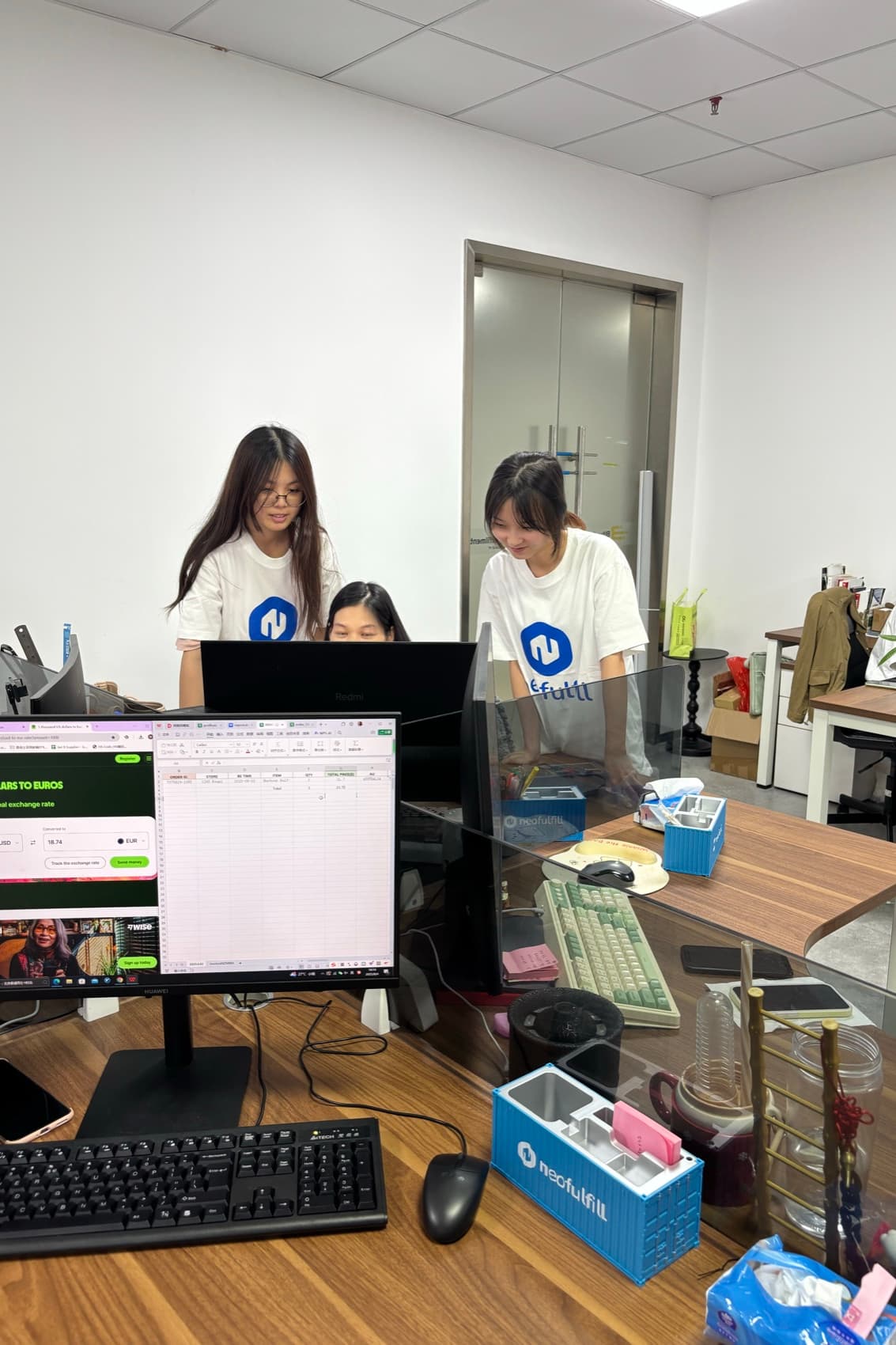
Two people on the same screen
A delivery problem is worked by whoever can close it, together, against the order it belongs to. That is why the answer is a decision and not a ticket number.
Photographed in the Neofulfill office in Shenzhen.
Returns & After-Sales Support FAQs
Where do my customers send returns?
Do returned items go back into my sellable stock?
How do I find out if a product is being returned repeatedly?
What is the refund and reshipment policy?
Ready to hand over fulfillment?
Tell us your daily order volume and main markets. We come back with the routes and the per-order price your actual profile needs.