
Fulfillment cost per order: where the money actually goes
The eight lines that make up fulfillment cost per order, which ones move with volume, and why two quotes for the same order can differ and both be honest.
9 min read
Neofulfill sells fulfillment, so treat this as interested. The figures below are market benchmarks and common practice, not Neofulfill prices — we do not publish a rate, for the reason set out at the end.
"What does fulfillment cost per order" is the most asked and least answered question in this business. The usual response is a range so wide it tells you nothing, or a number with no scope attached, which is worse.
The honest version is structural. Fulfillment cost per order is not one number, it is eight lines. Once you can see the lines, you can compare quotes that looked incomparable, and you can tell which ones get better as you grow.
The eight lines
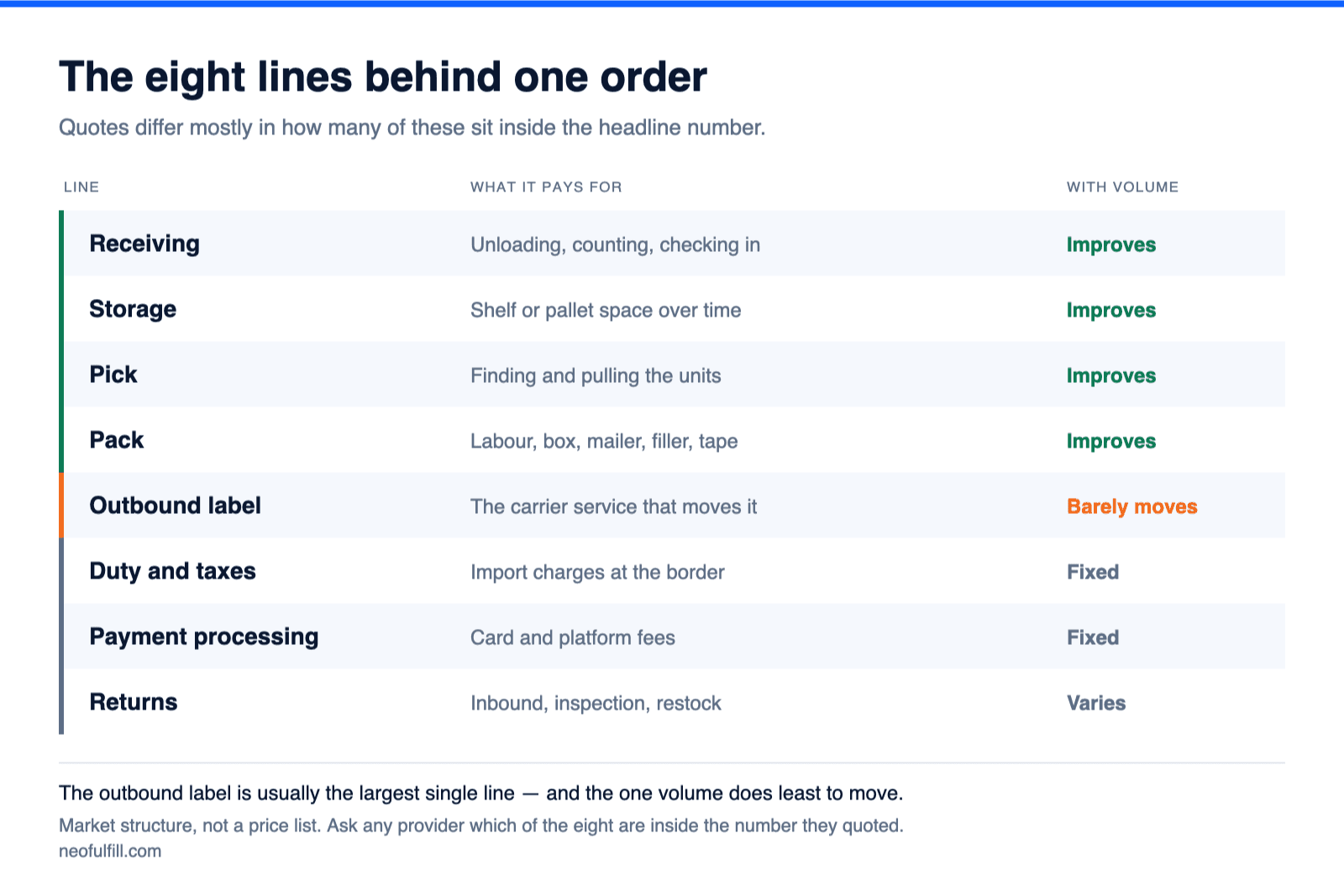
Every order carries some version of these. What varies between providers is which ones sit inside the headline figure and which arrive separately.
| Line | What it pays for | Moves with |
|---|---|---|
| Receiving | Unloading, counting, checking goods in | Cartons received, not orders |
| Storage | Shelf or pallet space over time | Volume held and how long |
| Pick | Finding and pulling the units | Units per order |
| Pack | Labour and the box, mailer, filler, tape | Packaging spec |
| Outbound label | The carrier service that moves it | Weight, size, destination |
| Duty and taxes | Import charges at the border | Value, classification, destination |
| Payment processing | Card and platform fees | Order value |
| Returns | Inbound, inspection, restock or write-off | Return rate and category |
Two of these dominate for most sellers, and they are not the ones people negotiate. The outbound label is usually the largest single line, and returns is the one most often left out of the model entirely.
Why the cheap quote gets expensive
A provider quoting a low per-order figure and one quoting a figure half as much again can be charging the same money. The first may be quoting pick and pack only, with receiving, storage, packaging materials and the outbound label invoiced separately.
This is rarely deception. It is two companies drawing the boundary of the word "fulfillment" in different places.
Which is why the comparison that works is not price against price. It is: take the eight lines above, and ask each provider which ones are in the number they just gave you. The spread usually collapses.
Which lines improve with scale, and which do not
Worth knowing before you plan around growth, because half of this does not improve at all.
- Improves with volume. Storage rates, per-order handling, packaging bought in quantity. These are the lines a provider can move.
- Barely moves. The outbound label, which is priced on weight and distance. A carrier does not care how many orders you send this month in the way a warehouse does.
- Does not move. Duty, taxes, payment processing. These are percentages of value set by somebody else.
The practical consequence: sellers who negotiate hard on pick-and-pack and ignore packaging weight and parcel dimensions are optimising the smaller half. Shaving a parcel into a lower weight band usually beats a rate negotiation.
Where the stock sits, which decides more than the rate
The largest cost lever is not a line item. It is a decision about geography.
Stock held in your customer's region ships domestically: cheaper per label, faster, and it ties up cash in inventory sitting far from where it was made. Stock held in China ships internationally: more per label, slower, and far less cash committed.
Neither is correct in general. China 3PL versus a domestic 3PL sets out the trade properly. On the China to United States lane we see 6 to 12 days on standard service and 3 to 5 on express, destination-dependent — ranges from our own shipments, not a guarantee.
The sourcing fee, and the four structures the market uses
If someone is buying on your behalf as well as shipping, there is a fee for that, and the structure matters more than the rate because each one points the incentive somewhere different.
| Structure | Their income rises when | Watch for |
|---|---|---|
| % of order value | The supplier price rises | Weak incentive to negotiate hard for you |
| Fixed fee per order | You order more often | Income decoupled from how well they buy |
| Margin inside the price | The spread widens | This is reselling, not representation |
| Retainer | Nothing changes | Alignment is good, cost is fixed regardless of volume |
These are the structures in common use across the market, not anyone's published prices. How to compare China sourcing agents goes further into reading a quote, and the nine steps of sourcing from China covers where cost enters before fulfillment does.
Why we do not publish a rate
Having spent an article arguing for transparency, it is fair to say where we land, and it is not behind a number.
A published per-order rate would have to assume a product, a weight, a destination mix and a volume. Change any one of those and the figure is wrong in a way that favours whoever published it, because the assumptions sit in the small print and the number sits in the headline.
So we quote against the actual project: what you sell, the volume it does, the nature of the product and the markets it goes to. Contact us with those four and we come back with the lines, including the ones we would charge separately.
What you should take from this article regardless of who you use: ask any provider which of the eight lines are inside their number. The ones who answer quickly are the ones who have thought about it.
Dropshipping fulfillment from China and China sourcing set out what each side actually covers.
Common questions
What is the average fulfillment cost per order?
What is included in fulfillment cost per order?
Why do two fulfillment quotes differ so much?
Does fulfillment cost per order go down with volume?
What does a sourcing agent charge?
Is it cheaper to fulfill from China or from the destination country?
Want a number for your own order profile?
Send your product, your monthly volume and your destination mix. We quote against what your project actually needs rather than a published average — contact us and we will come back with the lines.