
DSers, CJ and Zendrop alternatives: what you are actually replacing
The three tools solve different problems, so they have different alternatives. What each one does, what it never did, and what replacing it changes.
8 min read
Neofulfill is one of the alternatives this article would lead you to, which is a conflict of interest. Every description below is of what each tool publishes about itself, checked in October 2026, and the criteria come before the comparison so you can apply them to tools not named here.
These three names are searched for as though they were interchangeable. They are not, and the difference decides what a replacement has to be able to do.
Two of them are software that sits between your store and a supplier. One of them holds stock. Replacing software with software, when the thing that failed was physical, is the most common wasted migration in this business.
What each one actually is
| What it is | Holds your stock | Packs your order | |
|---|---|---|---|
| DSers | Order automation for a marketplace | No | No |
| Zendrop | A supplier network with automation | No | No |
| CJ Dropshipping | An operation with its own warehouses | Yes | Yes |
The first two columns are the whole article. Software changes how an order is placed. It does not change who holds the goods, who packs the box, or how long the customer waits, because it does not touch any of them.
That is not a criticism. Automating repetitive ordering across dozens of SKUs is real work and saves real hours. It is a statement about scope, and the scope is where migrations go wrong.
Diagnose the failure before choosing the replacement
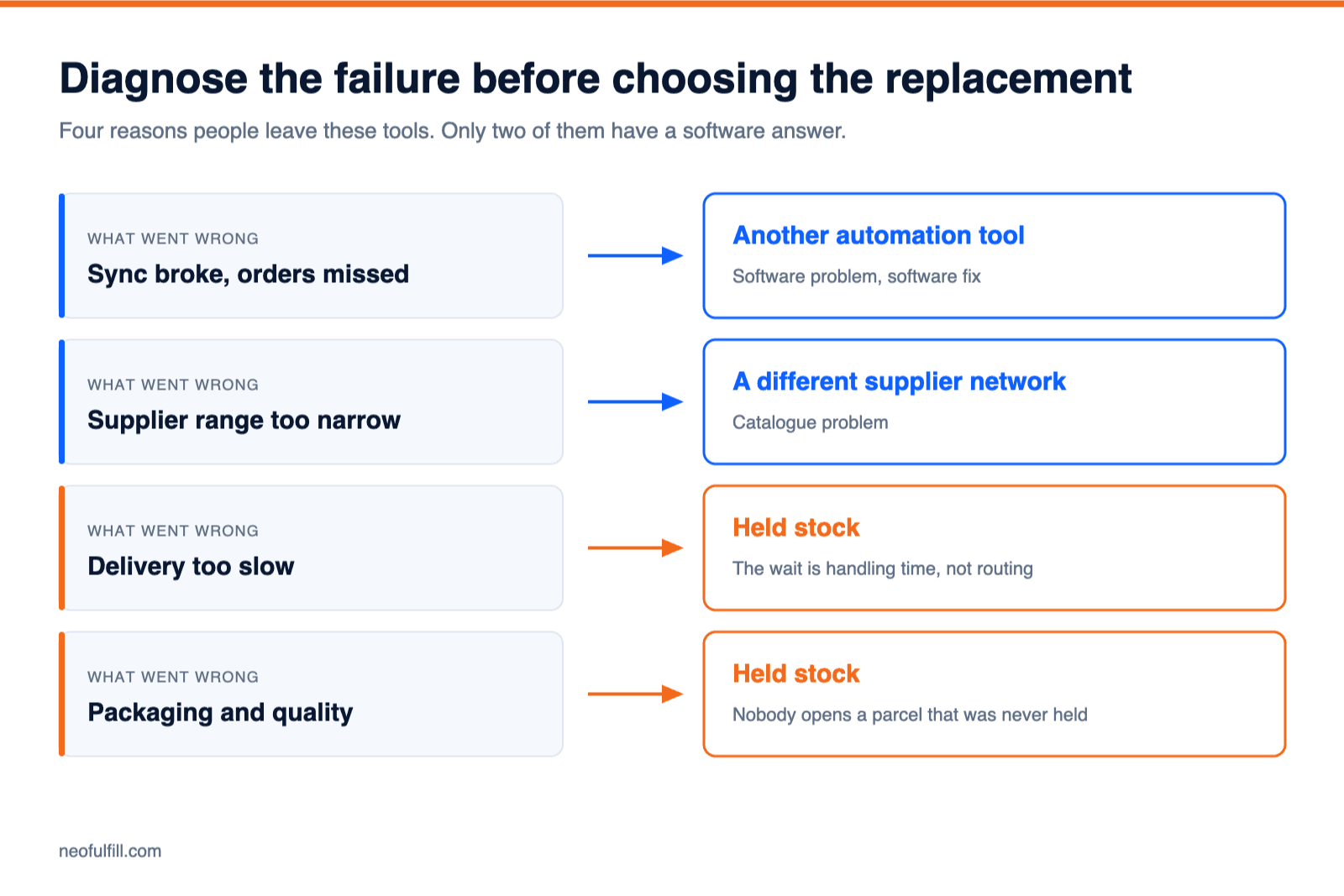
Four things send people looking for an alternative. Only two of them have a software answer.
| What went wrong | Replace with | Why |
|---|---|---|
| Sync broke, orders missed | Another automation tool | Software problem, software fix |
| Supplier range too narrow | A different supplier network | Catalogue problem |
| Delivery too slow | Held stock | The wait is handling time, not routing |
| Packaging and quality | Held stock | Nobody opens a parcel that was never held |
Rows three and four are the ones that matter, because they are the most common reason people switch and the reason a switch between apps changes nothing.
Why switching apps does not change delivery time
Break the wait into its parts. The order reaches the supplier. The supplier picks and packs it, eventually. The parcel enters a postal or courier network. It crosses a border. It is delivered.
An app changes the first step, from a human copying an order to a machine sending it. That step was never the slow one.
The slow one is the second: a supplier who holds no stock earmarked for you, handling your single order between production runs. That delay is invisible in every delivery estimate because nobody measures it, and it survives every migration between tools that order from suppliers.
It is removed by one thing only — the goods already being in a warehouse when the order arrives. Then the first step is picking, not ordering.
What the alternatives actually are
Another automation tool. Correct when the failure was a sync, a missed order or a pricing rule. Nothing else changes, which is fine if nothing else was wrong.
Another supplier network. Correct when the catalogue was the limit. The model is identical: you order per sale from suppliers the platform does not own.
Buying agent plus held stock. Someone sources, negotiates and inspects, and the goods sit in a warehouse against your orders. This is what people usually mean when they say the apps did not work. What a dropshipping agent does covers the arrangement, including when you do not need one.
A fulfilment operation. The goods are received, checked, stored and packed per order under your branding. It is the only option on this list that touches packaging and quality, because it is the only one where somebody handles the goods before your customer does.
AliExpress alternatives sets out the same three-model distinction across a wider list, and how to qualify a Chinese supplier covers the sourcing side of the last two options.
When each one is the right answer
- Still testing products. Keep the app. Placing orders by hand across dozens of SKUs is wasted time, and holding stock before you know what sells is the expensive mistake.
- A handful of SKUs carry the revenue. Move those to held stock and leave the rest on the app. The split is better than the switch, and almost nobody runs it.
- Delivery time or returns are the complaint. The app layer is not the problem and replacing it will not help. Stock has to move.
- Branding matters now. Only an arrangement where someone packs your order can put your packaging in the box.
Around 10 orders a day is where fulfilment of any kind starts paying for itself. Below that the coordination costs more than it saves, and the apps are doing the right job.
What changes when stock is held
The order arrives at a warehouse where the goods already are, and it is picked rather than ordered. The supplier's handling time leaves your customer's wait entirely.
The goods were examined when they were received, so a bad batch is caught in a warehouse rather than by the person who bought it. Your packaging goes in the box, because somebody is packing your order rather than forwarding somebody else's parcel.
On the China to United States lane we see 6 to 12 days on standard service and 3 to 5 on express, destination-dependent — ranges from our own shipments rather than a guarantee. Dropshipping fulfilment from China sets out how it runs, including the parts that stay your responsibility.
What does not change: you still need the right product and the right supplier behind it. Held stock removes the handling time and the packaging problem. It does not make a bad SKU sell.
Common questions
What is the best DSers alternative?
What is the difference between DSers, CJ Dropshipping and Zendrop?
Why is my dropshipping delivery still slow after switching apps?
Can I use my own packaging with these tools?
Do I need an app at all?
What replaces these tools at higher volume?
Outgrown the app layer?
Send your order volume, your SKU count and your destination mix. We come back with what holding stock would do to your delivery times and what it would cost per order.