
Chinese dropshipping suppliers: how to find and qualify one
The four kinds of Chinese dropshipping suppliers, how to tell which one you are talking to, and the checks that separate a factory from a reseller.
9 min read
Neofulfill works with suppliers in China, which is a conflict of interest when writing about how to choose one. The criteria below are the ones we apply ourselves, and they are stated so you can apply them to anyone — including us.
Searching for Chinese dropshipping suppliers returns a list of names. It almost never returns the thing that decides whether the relationship works, which is what kind of supplier each name is.
The phrasing varies — Chinese dropshipping suppliers, China dropshipping suppliers, dropshipping suppliers China — and the question underneath all three is the same: who am I actually buying from?
There are four kinds. They quote differently, fail differently, and suit different stages of a business. Telling them apart takes about two questions, and most buyers never ask either one.
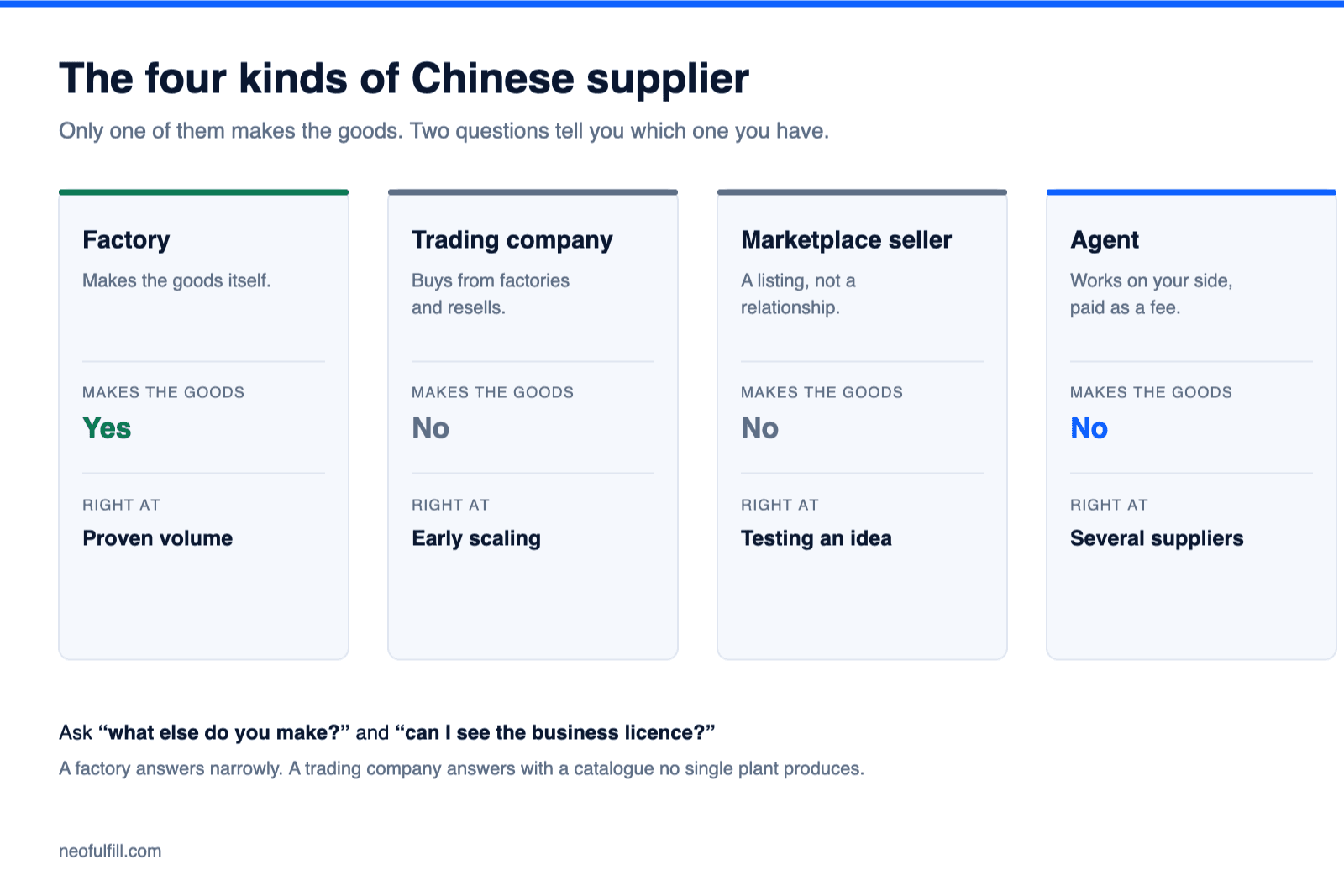
The four kinds of supplier
The factory. Makes the goods. Best unit price at volume, usually the slowest to answer an email in English, and often uninterested in small quantities because the setup cost is the same whether you order 200 units or 20,000.
The trading company. Buys from factories and resells. Handles export paperwork, speaks your language, takes smaller orders, and adds a margin for it. This is what most buyers are actually dealing with, including many who believe otherwise.
The marketplace seller. A listing rather than a company you have a relationship with. Fine for testing, because you can order one unit and find out whether the product sells at all. It is not a supply chain.
The agent. Works on your side rather than selling you goods: finds the factory, negotiates, inspects, consolidates. Paid by you rather than on the margin, which is the distinction that matters. How a sourcing agent works covers the arrangement and where it stops being worth it.
| Factory | Trading company | Marketplace seller | Agent | |
|---|---|---|---|---|
| Makes the goods | Yes | No | No | No |
| Small quantities | Rarely | Yes | Yes | Yes |
| Export paperwork | Sometimes | Yes | Platform handles it | Yes |
| Paid by | You, per unit | You, in the margin | You, per order | You, as a fee |
| Right at | Proven volume | Early scaling | Testing an idea | Several suppliers at once |
None of these is the right answer in general. A trading company is often the correct choice early, and a factory is often the wrong one: a factory that does not want your order will deprioritise it the moment a larger one arrives, and you will discover this in week six.
The two questions that establish which one you have
"What else do you make?" A factory answers with a narrow range, because a production line makes what it is tooled to make. A trading company answers with a catalogue spanning categories no single plant produces.
"Can I see the business licence?" Every registered Chinese company has one, it names the registered business scope, and a manufacturer's scope says so. A trading company's scope says trade. This is a public document and asking for it is routine; a refusal is itself the answer.
A trading company is not a red flag. Being told you are dealing with a factory when you are dealing with a trading company is, because it means the first substantive thing you were told was untrue.
What "dropshipping" means to a Chinese supplier
To you, dropshipping means the supplier ships each order to your customer under your brand. To most Chinese suppliers it means they will post single parcels if you ask, as a favour attached to a wholesale relationship.
The difference shows up in three places, and all three reach your customer.
Handling time. A supplier packing single parcels between production runs does it when there is a gap. That gap is in your customer's wait, and it is not in any delivery estimate you were given.
Packaging. The parcel leaves in whatever the supplier uses, often with the supplier's own documentation inside it. Your brand is not on the box because nobody was asked to put it there.
Inspection. Nobody opens the parcel. The first person to examine the goods is the customer who paid for them, which makes your returns rate your quality system.
This is why the question is not only who the supplier is, but who holds the stock. Goods sitting in a warehouse can be checked before they are put away. Goods posted from a production floor cannot.
Where to find them
Alibaba. Export-facing, English, international payment. Good at discovery and payment and explicitly not a quality system.
1688. Alibaba's domestic marketplace, priced for Chinese businesses. The same goods cost less because there is no export layer, and in exchange it is in Chinese, pays in RMB, and ships only inside China. Most buyers need an agent to use it at all.
Made-in-China and Global Sources. Export directories with a stronger manufacturer skew than the consumer-facing platforms. Still directories: a listing is a paid placement, not a verification.
Canton Fair and trade shows. Slow, and the highest signal per hour available, because you are looking at goods and the people who make them at the same time.
Referral. The channel with the best outcomes and the least coverage in articles like this one, because it does not scale into a list.
Note what every platform badge means: that a fee was paid and documents were filed. It is a filter, not a verification, and it is routinely read as the second thing.
The checks that actually separate suppliers
Four, in the order they are worth doing.
- Business licence, checked against the claim. Registered scope, registered capital, year of registration. Minutes of work, and it settles the factory-or-trader question in writing.
- A sample you did not choose. A sample selected and sent by the supplier is a marketing asset. A sample pulled from a production batch is evidence. These are not the same object.
- Reference to a buyer in your market. Not a logo wall — a buyer shipping to the same destination with the same compliance requirements you have.
- Someone looking at the goods before the balance payment. The only check on this list that cannot be satisfied with a document, and the only one that catches a batch that is wrong rather than a company that is fake.
The first three cost an afternoon. The fourth needs a person in the country, which is the part that makes it the one most often skipped and the one that most often matters.
When a supplier stops being the right unit of decision
Below roughly 10 orders a day, finding a good supplier is the whole problem, and the right move is to test cheaply on a marketplace until something sells.
Above it, the supplier stops being the bottleneck and the gap between supplier and customer becomes it: handling time, packaging, inspection, and the fact that every order crosses a border individually.
That is the point at which stock held somewhere changes the arithmetic, because the factory lead time comes out of your customer's wait entirely. On the China to United States lane we see 6 to 12 days on standard service and 3 to 5 on express, destination-dependent — ranges from our own shipments, not a guarantee.
Dropshipping fulfilment from China sets out how that is run, and what a dropshipping agent does covers the case where you want someone managing the suppliers rather than replacing them.
Common questions
How do I find Chinese dropshipping suppliers?
Are Chinese dropshipping suppliers reliable?
What is the difference between a factory and a trading company?
Do Chinese suppliers dropship directly?
What minimum order quantity do Chinese dropshipping suppliers require?
How do I verify a Chinese supplier before paying?
Already have a supplier you want checked?
Send the supplier details and what you are ordering. We can tell you what they actually are, and what we would inspect before a batch ships.