
China sourcing cities: where to buy what
A map of where Chinese production actually sits: Guangzhou, Foshan, Dongguan, Shenzhen and Yiwu, what each one is good at, and when the city matters more than the platform.
9 min read
Neofulfill operates from Shenzhen and sources across the Pearl River Delta and the markets beyond it. We do not have an office in every city named below, and no article should imply otherwise — what matters is whether someone can be at the factory, which in this region is a drive rather than a flight.
Chinese manufacturing is not spread evenly across the country. It clusters, hard, and the cluster your product belongs to decides more than most buyers expect: the price you are quoted, the minimum you are offered, and how quickly a problem gets fixed.
What follows is where the clusters are, what each is actually good at, and the question that matters more than any of it — whether the city matters at all for your project.
The Pearl River Delta, and why it behaves as one place
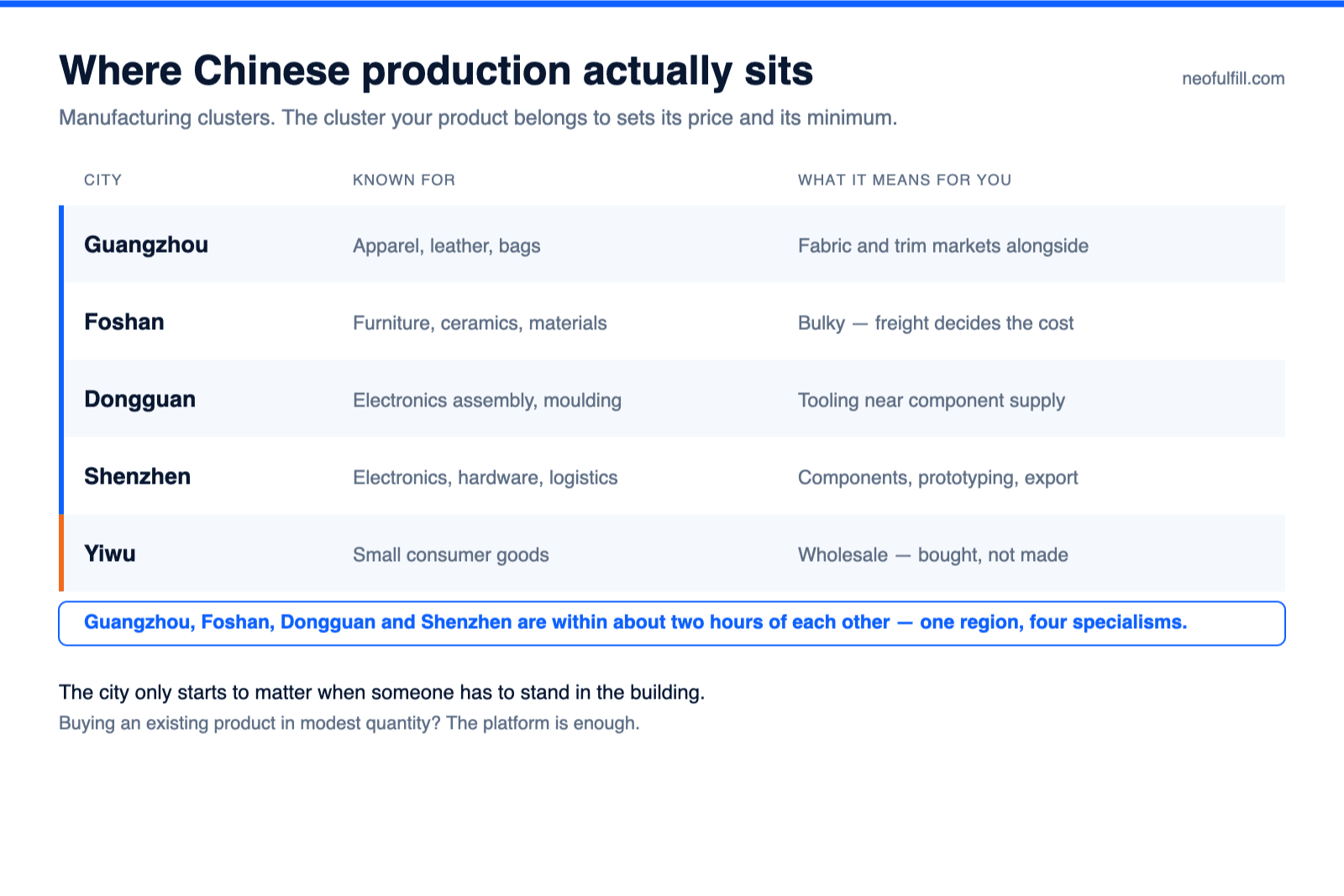
Guangzhou, Foshan, Dongguan and Shenzhen sit within about two hours of each other. For sourcing purposes they are not four cities, they are one dense industrial region with four specialisms, and a component made in one is routinely finished in another.
That proximity is the practical point. A buyer asking for a guangzhou sourcing agent usually does not need someone who lives in Guangzhou — they need someone who can be at the factory this week, and anywhere in the delta is a drive from anywhere else in it.
| City | Known for | What that means for you |
|---|---|---|
| Guangzhou | Apparel, leather, bags, accessories | Deep fabric and trim markets in the same place |
| Foshan | Furniture, ceramics, building materials | Bulky goods, so freight dominates the landed cost |
| Dongguan | Electronics assembly, plastics, moulding | Tooling and injection work close to component supply |
| Shenzhen | Electronics, hardware, logistics | Components, prototyping and export in one city |
| Yiwu | Small consumer goods, wholesale | Low minimums, bought by the carton rather than made |
Guangzhou: apparel, and everything that goes on a garment
Guangzhou's depth is in textiles and leather. The useful part is not the factories alone but the markets beside them: fabric, trims, zips, labels and hardware sold in concentrated wholesale districts within reach of the people sewing.
That matters because apparel fails on trims more often than on sewing. A garment waiting on labels is the most common cause of a late shipment, and a region where the trim supplier is twenty minutes away behaves differently from one where it is in another province. What an apparel sourcing agent actually does covers that chain in detail.
Foshan: furniture, ceramics, and the freight problem
Foshan is the furniture and ceramics centre, and it comes with a cost structure most buyers underestimate: these goods are bulky, so freight, not the unit price, usually decides whether the project works.
A foshan sourcing agent earns their fee on the loading plan as much as on the negotiation — how the goods pack into a container, what gets flat-packed, and whether the quoted price includes the crating that bulky goods need. Get a quote per cubic metre landed, not per unit at the factory gate.
If the product is bulky, read air and sea freight before you read the factory quote. The freight decision is upstream of the sourcing decision here, not downstream.
Dongguan and Shenzhen: electronics, tooling and prototypes
Dongguan is assembly, plastics and moulding. Shenzhen is components, prototyping and export. In practice a hardware project touches both: the mould is cut in one, the board is populated in the other, and the finished unit ships from the port.
For anything with tooling, proximity to the mould maker is worth more than a lower unit price. A mould that needs three revisions is three trips, and whether those are drives or flights is the difference between a fortnight and a quarter.
Yiwu: buying, not manufacturing
Yiwu is the outlier on this list because it is not a production cluster. It is the largest wholesale market in the world for small consumer goods, and its defining feature is the minimum: where a factory wants thousands, Yiwu will sell you dozens.
That makes it right for testing a range, for gifts and seasonal goods, and for anyone whose quantities do not justify a production run. It makes it wrong for anything you want made to your own specification. Sourcing from Yiwu sets out where that line sits.
The question that decides whether the city matters at all
Here is the part most city guides leave out: for a large share of projects, the city is irrelevant, because the platforms already index the same factories.
A sourcing agent for 1688 reaches the domestic marketplace where those factories list, at domestic prices, without anyone travelling anywhere. What an agent does on 1688 covers how that runs, and 1688 vs Alibaba covers which platform you should be on in the first place. Alibaba is the export-facing route to much of the same supply base.
The city starts to matter at exactly one point: when someone has to stand in the building. Approving a first sample against a specification, watching a line run, resolving a dispute about what was agreed — none of that happens over a platform.
- Buying an existing product in modest quantity? The platform is enough. The city is a detail.
- Making something to your specification? The cluster matters, because tooling, trims and components are local.
- Bulky goods? Freight decides it before the factory does.
- Repeat production you intend to scale? Proximity to the people making it is worth paying for.
What to ask, whatever the city
The city narrows the search. It does not qualify the supplier, and the checks are the same everywhere.
Business licence against the claim, certification that names your product and your market, a reference from a buyer shipping where you ship, and someone looking at the goods before the balance payment. How to qualify a Chinese supplier sets out the four in order, and the audit checklist is the version you can hand to someone else.
We work from Shenzhen, which puts the delta within a drive and Yiwu within a short flight. Where the project warrants it we go to the factory and meet the people who work there — not on every project, and we say which.
Common questions
What is the best city in China for sourcing?
Do I need a Guangzhou sourcing agent specifically?
What is the difference between Yiwu and Guangzhou?
Is Foshan only for furniture?
Can I just use 1688 instead of going to a city?
Does the city change the price?
Not sure where your product is made?
Send the product and the quantity. We work from Shenzhen, and the delta is a short drive — we check certifications, reputation and reviews from the factory's own customers, and where the project warrants it we go to the factory.