
Branded dropshipping: what branding actually costs at the factory
Where a brand can be applied, why the minimum order follows the branding rather than the product, and what to brand first when you are still testing.
By the Neofulfill team in Shenzhen — we source, inspect and ship the goods these guides cover.
10 min read
In this article7 sections
Neofulfill does not manufacture. We find and qualify factories, coordinate samples and production, inspect before shipment and ship the goods. Everything below describes what branding demands of whoever makes a product, not something we make ourselves.
Search branded dropshipping and the results are platform pages: Shopify, Wix, Printful, AutoDS, a Reddit thread. They agree on the premise — branding is how you stop competing on price with everyone selling the same unbranded item — and they are right about it. What none of them covers is the part that happens at the other end of the chain, because none of them is standing in a factory.
The question that decides whether branded dropshipping works for you is not which platform you use. It is where on the shipped object the brand appears, because that single choice sets the minimum order, the lead time and the amount of cash committed before anything sells.
What is branded dropshipping?
Branded dropshipping is dropshipping where the goods carry the seller's brand rather than the supplier's or none at all. The fulfilment model is unchanged: orders still ship per order, from a warehouse that is not yours. What changes is that branded stock has to exist before the first order arrives, because nobody prints a logo on demand on a product that is already sitting in a box.
That one sentence is the whole difference, and it is where the platform guides stop.
The four places a brand can go, and what each one costs you
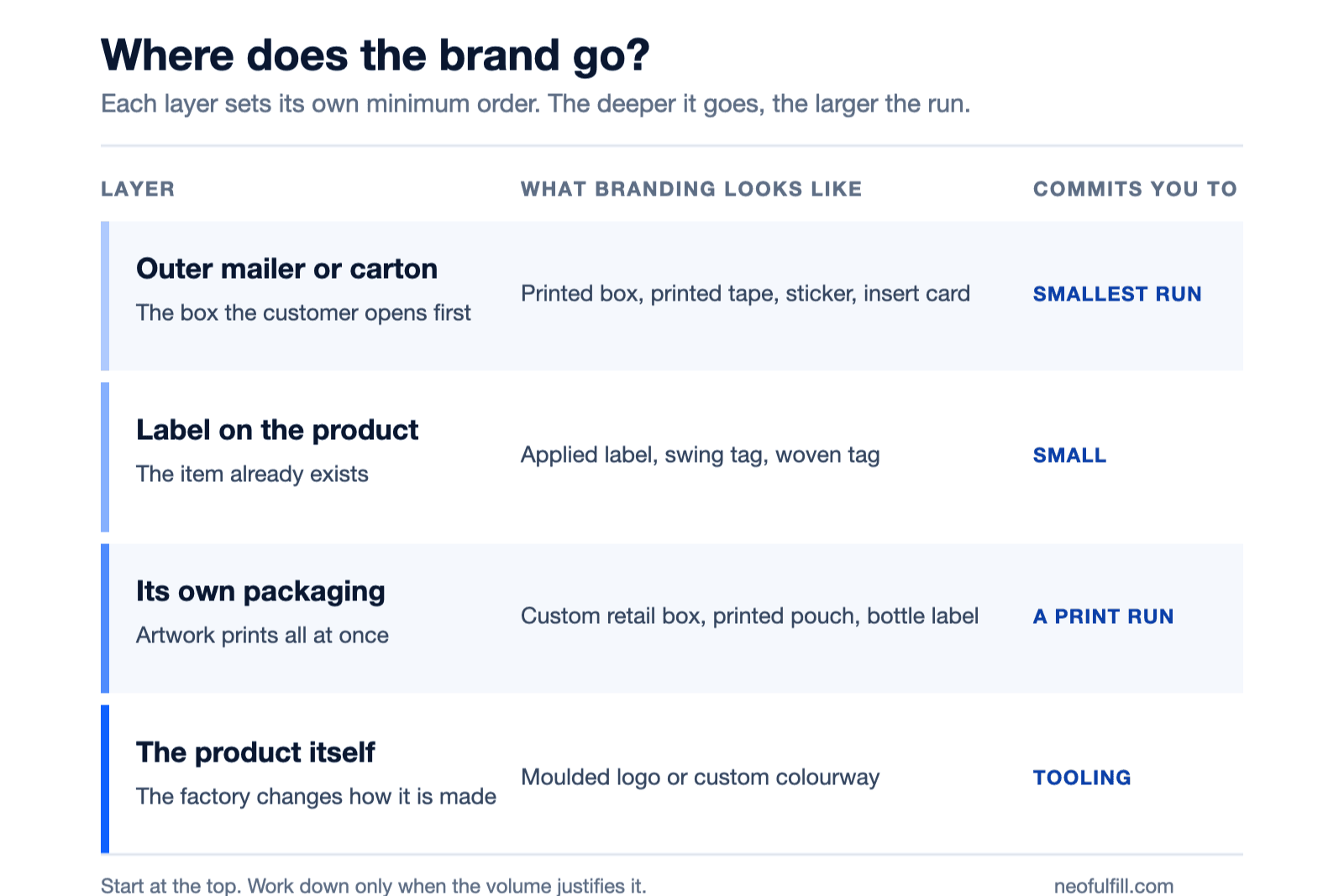
Every branded order is a stack of four layers. A brand can be applied to any of them, and they are not interchangeable — each sits at a different point on the scale of commitment.
| Layer | What branding looks like | What it commits you to |
|---|---|---|
| Outer mailer or carton | Printed box, printed tape, a sticker, an insert card | The least. Printing is a job with its own run, and it is independent of the product inside. |
| Label on the existing product | A label on a supplier's generic item, a swing tag, a woven tag | Small. The product is already made; the label is a step added to it. |
| The product's own packaging | A custom retail box, a printed pouch, a bottle label | A print run with setup. Artwork has to be right before it runs, because the whole quantity is printed at once. |
| The product itself | A moulded logo, a custom colourway, a changed shape | The most. The factory may have to change or cut a tool, and that cost is recovered over the run. |
Read that table downward and it is a budget ladder. Most people who ask about branded dropshipping are imagining the fourth row and pricing the first.
Why the minimum order follows the branding, not the product
This is the part that surprises people. A supplier's minimum on a generic item might be low, because the item already exists in their warehouse. The moment you ask for your brand on it, the minimum stops being about the product and starts being about the branding step.
A printer does not set up a press for forty boxes. A factory does not change a mould for a hundred units. The setup cost is fixed, so it is spread across the run, and the run has to be large enough for the spread to make sense. That is why two sellers can be quoted very different minimums for the same product: one asked for a sticker, the other asked for a mould.
This is why the category matters as much as the product. Private label product categories works through which categories need tooling before the first unit and which only need a formulation or a finish.
Print on demand is branded dropshipping with the minimum absorbed
Print on demand gets treated as a separate thing, and it is not. It is the second row of that table, run by someone who has already paid for the first three. The printer holds blank garments and mugs, decorates per order, and carries the inventory risk you would otherwise carry.
That is a real service and the branding is real. What you give up is margin and depth: the blank underneath is from their catalogue, in their colours, at their quality, and no amount of design work changes it. For a first test that is the right trade. For a brand that intends to be a brand, the blank eventually becomes the constraint.
What to brand first, if you are testing
Start at the top of the table and work down only when the volume justifies it. In practice that means the unboxing before the product.
- A printed mailer and an insert card. The customer sees these before anything else, the run is independent of the product, and you can change them without touching your stock.
- A label or a swing tag on the existing item. Turns a generic product into yours without asking the factory to change how it is made.
- Retail packaging, once a product is proven. This is where a print run and artwork sign-off start to matter, and where a mistake becomes expensive because the whole quantity prints at once.
- The product itself, last. Tooling is a real commitment and it is worth making only for a product you already know sells.
Sellers who do this in reverse — tooling first, packaging later — are the ones who end up with a garage of branded stock and no demand data. The order matters more than the budget.
Where branded dropshipping goes wrong
Three failures recur, and none of them is about the product.
- Artwork that was never checked at production size. A logo that reads on a screen can close up or go muddy printed small, and the whole run carries the mistake.
- Branding that outruns demand. Committing to a tooled, moulded, custom-coloured version of a product with no sales history is the most common way to turn a test into dead stock.
- Assuming the supplier will catch a packaging error. They will produce what the file says. Barcodes that do not scan and missing market labelling are discovered at the destination warehouse, not in China — which is what a pre-shipment inspection is for.
Where this sits next to private label and OEM
The vocabulary around this is a mess, and the terms overlap. Branded dropshipping describes the business model: your brand, shipped per order. White label and private label describe how deeply the product is yours, and OEM versus ODM describes who designed it in the first place.
In practice they stack: a branded dropshipping store might start with a white-label product in a printed mailer and end with a private-label product in custom retail packaging, without ever changing how orders ship. The branding service covers the production side of that progression, and private label dropshipping covers the model itself.
Common questions
What is branded dropshipping?
Does branded dropshipping require holding inventory?
What is the minimum order for branded dropshipping?
Is print on demand branded dropshipping?
Can you put your logo on a product without a big order?
Ready to hand over fulfillment?
Tell us the product and where you want the brand to appear. We will come back with what that level of branding demands at the factory, and what it does to the minimum order.