
How to find a dropshipping supplier: the method, not a list
Not another list of directories: what to decide before you look, what each source is good at, and the four questions that disqualify a supplier fastest.
By the Neofulfill team in Shenzhen — we source, inspect and ship the goods these guides cover.
11 min read
In this article6 sections
Neofulfill is a sourcing partner, not a directory. This article is the method we use; it works whether or not you hand the work to anyone.
Search how to find a dropshipping supplier and you get the same article fifteen times: a list of six directories, in roughly the same order, with roughly the same descriptions. The list is not wrong. It is just not the difficult part.
Finding candidates takes an afternoon. Knowing which of them will still be answering emails when a batch goes wrong is the actual job, and no directory tells you that. What follows is a method rather than a bookmark.
Step 1 — decide what you are looking for before you look
Most searches fail here, before a single supplier is contacted. Three different things get called a supplier and they behave completely differently.
| What it is | What it does well | What it costs you |
|---|---|---|
| A manufacturer | Makes one category properly. Can change the product, the material, the tooling. | Higher minimums, less flexibility on mixed orders, often no English-language sales team. |
| A trading company | Sources across categories, handles export paperwork, takes small orders. | A margin on top, and no control over the factory actually making the goods. |
| An agent | Finds and qualifies suppliers, handles samples, inspection and freight on your behalf. | A service fee, and a relationship you have to choose well. |
A trading company is not a worse answer than a manufacturer. For a first run of a few hundred units across three products, it is often the right one. It becomes the wrong one when you need the product changed, because they cannot change it — they can only ask.
Step 2 — where to find dropshipping suppliers, by what each source is good at
Now the list, with the part the lists usually leave out: what each source is structurally good and blind to.
| Source | Good for | The catch |
|---|---|---|
| Export marketplaces (Alibaba and similar) | Starting. Built for foreign buyers, in English, with export-ready sellers. | Listings are sales pages. A factory and a reseller look identical there. |
| Domestic Chinese platforms (1688 and similar) | Price. It is where the export sellers often buy. | Assumes a Chinese account, a Chinese address and Chinese-language negotiation. |
| Trade fairs | Seeing the product and meeting the people in one afternoon. | Dates, travel, and a sales booth is still a sales booth. |
| Referral from another buyer | The highest-quality signal available, by a distance. | You have to know someone who will share, and most will not share a good one. |
| An agent on the ground | Reaching the suppliers who never list themselves anywhere. | You are choosing a partner, not a listing, so the qualification shifts to them. |
Chinese dropshipping suppliers goes into the platforms in more depth. If you are weighing the last row, how to find a sourcing agent in China is the matching method for that choice.
Step 3 — the questions that disqualify fastest
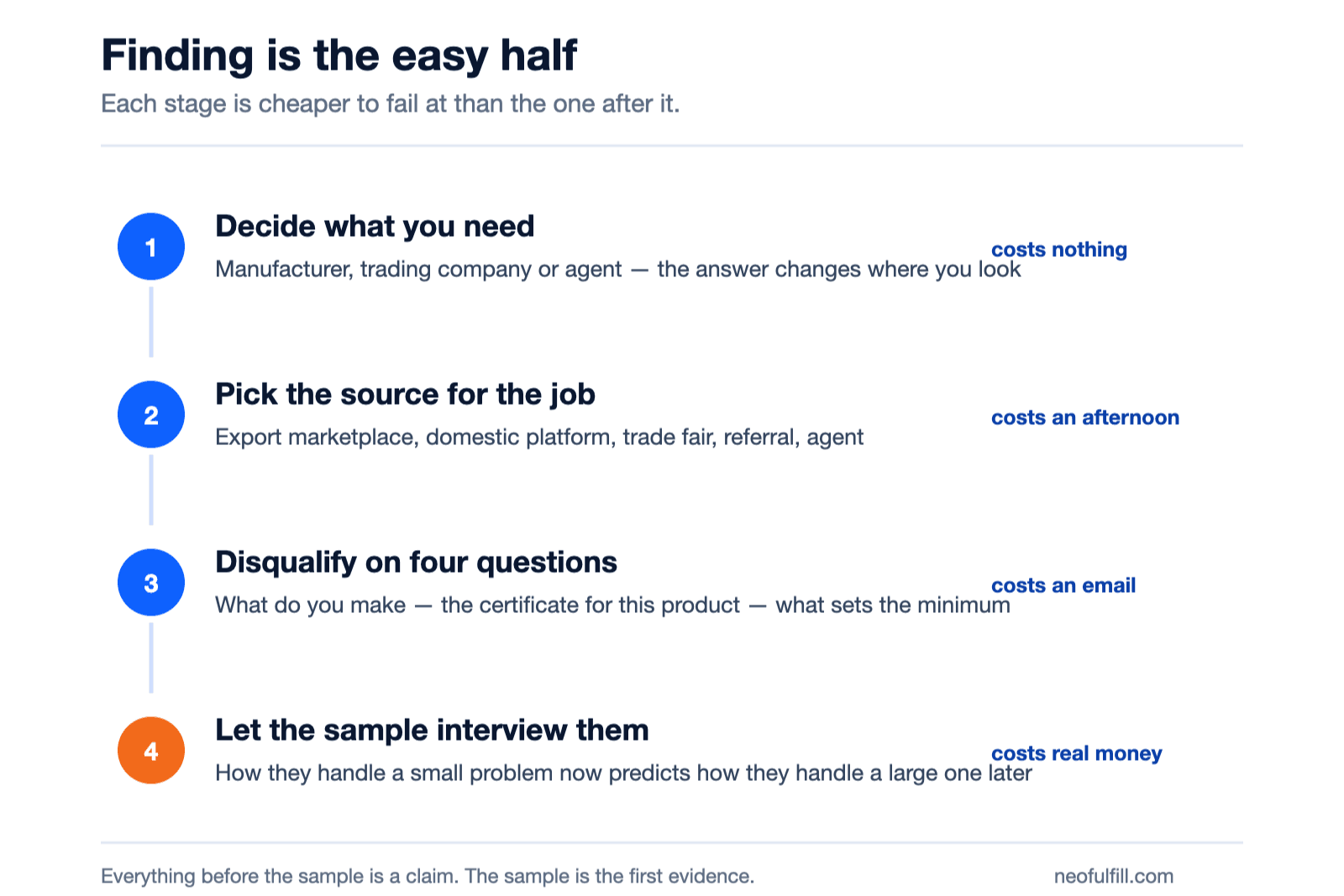
The goal of first contact is not to find a good supplier. It is to remove the bad ones cheaply, before you have spent anything. Four questions do most of that work.
- What do you manufacture? A manufacturer answers with a narrow category. A reseller answers with a catalogue. Neither answer disqualifies on its own — but an answer that does not narrow tells you which one you are talking to.
- Can you send the certificate for this product? Not a certificate. The one covering the item you are buying, current. A valid certificate for a different product is the single most commonly accepted piece of nothing in this trade.
- What is the minimum, and what changes it? A supplier who can explain what drives their minimum — tooling, a print run, a material order — understands their own production. One who only quotes a number may be relaying it from someone else.
- What happens if a batch fails inspection? The answer matters less than whether they have one ready. A supplier who has never thought about it is telling you something.
What you are testing across all four is not honesty. It is whether the person you are talking to has access to the facts. Supplier audits are how that gets confirmed rather than inferred.
Step 4 — the sample round is the real interview
Everything before the sample is a claim. The sample is the first evidence, and it tests two things at once.
The obvious one is the product: does it match the specification, the photographs and the conversation. The one people miss is the supplier: how long did the sample take, did they tell you when it slipped, did they ask clarifying questions or guess. A supplier who handles a small problem well at sample stage is the best available predictor of how they handle a large one in production.
Order the sample against a written specification, not a link. If the only reference is a listing photograph, there is nothing to hold the sample against, and a disagreement later has no resolution.
What finding a supplier for dropshipping does not solve
A good supplier makes good goods. They do not inspect those goods on your behalf, they do not consolidate three suppliers into one shipment, they do not handle a customs classification question, and they have no particular reason to tell you when a batch is marginal rather than bad.
That gap is the whole reason sourcing exists as a service. Whether you fill it yourself, hire someone locally, or hand it to a China sourcing partner is a decision about your own time and volume — but the gap does not close by finding a better supplier.
The short version
- Decide whether you need a manufacturer, a trading company or an agent before you search. The answer changes where you look.
- Treat every source as structurally good at something and blind to something else.
- Use first contact to disqualify, cheaply and fast.
- Let the sample round interview the supplier, not just the product.
- Expect finding a dropshipping supplier to solve the production problem and none of the logistics ones.
Common questions
Where do you find dropshipping suppliers?
How do you know if a dropshipping supplier is legitimate?
What is the difference between a dropshipping supplier and a sourcing agent?
Can you find a dropshipping supplier without ordering samples?
Ready to hand over fulfillment?
Send the product, the target quantity and the destination market. We will tell you what kind of supplier that actually needs, and run the search and the qualification against it.