
Dropshipping returns: who pays, and what happens to the goods
Why returning a dropshipped order to China rarely makes sense, the four options that exist, and the two things that cause most returns before quality does.
By the Neofulfill team in Shenzhen — we source, inspect and ship the goods these guides cover.
10 min read
In this article7 sections
Neofulfill runs fulfillment, shipping and after-sales support from Shenzhen. This article describes how returns work in this model generally; nothing below is a legal or customs opinion, and consumer return rights differ by market.
Most dropshipping return policies are written in an afternoon, copied from a template, and published before anyone has asked the only question that matters: when a customer sends something back, where does the physical object go?
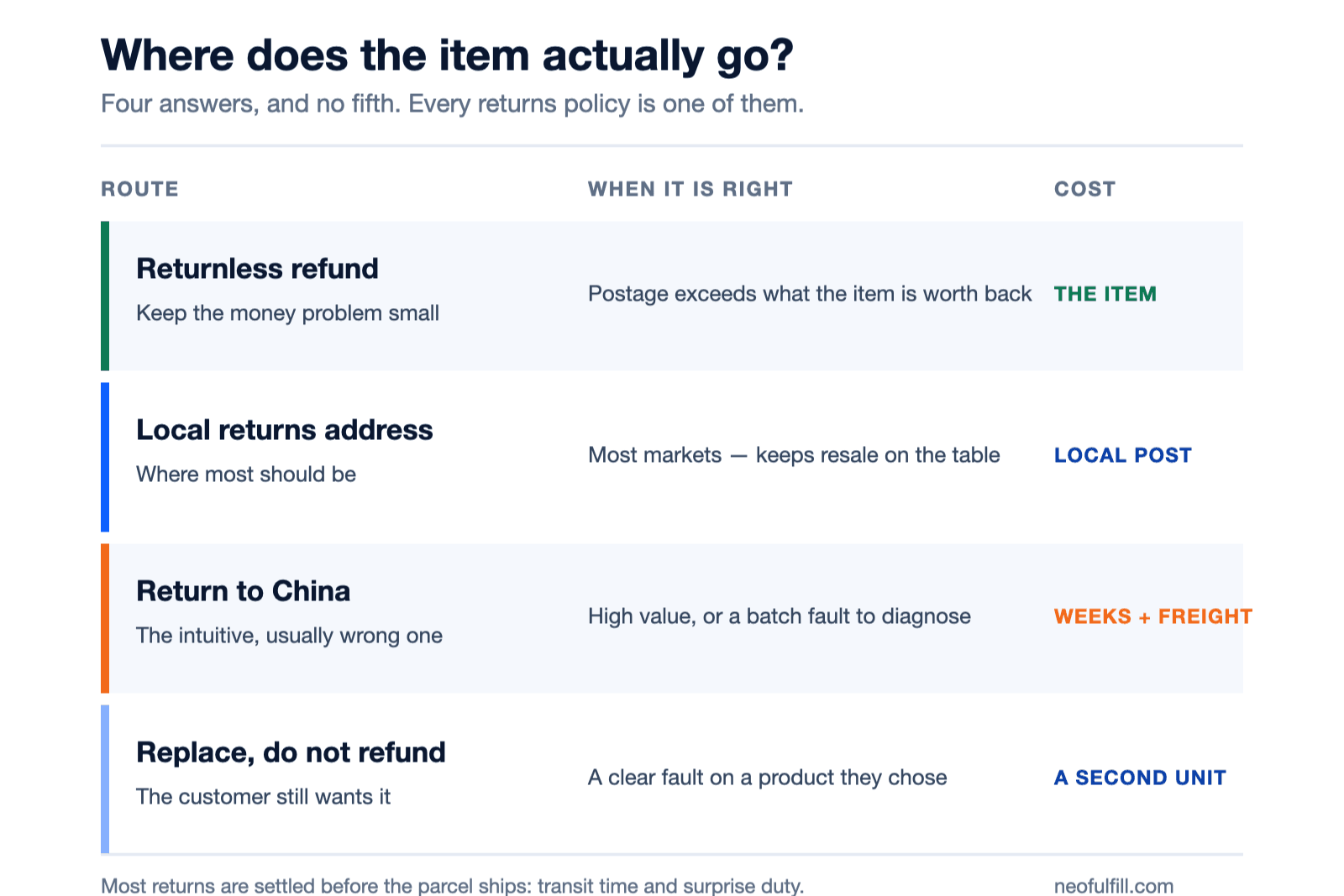
That question has four answers and no fifth. Every policy is one of them, whether or not the person who wrote it knew they were choosing.
Who pays for dropshipping returns?
The seller does. The customer bought from the store, so the store owes the refund, the correspondence and the time, regardless of who shipped the parcel or which country it left from. A supplier may agree to share the cost of a defect they caused, but that is something negotiated in advance and written down, not a default anyone can rely on.
This matters more in dropshipping than in domestic retail because the seller usually has no building. In conventional ecommerce the returned item goes back to the warehouse it came from. Here there is often nowhere for it to go at all, and that gap is where return policies quietly start costing money.
The four things that can happen to a returned order
| Route | What it costs | When it is the right answer |
|---|---|---|
| Returnless refund | The item, and nothing else | Low-value goods, where postage and handling exceed what the item is worth recovered |
| Return to a local address | Local postage, plus somewhere to put it | Most markets, most of the time — it keeps the resale option open |
| Return to China | International postage and weeks of transit | High-value items, or a batch defect the supplier genuinely needs to see |
| Replace, do not refund | A second unit and its shipping | A clear fault on an item the customer still wants |
Read that table and the middle row is where most businesses should be and where fewest actually are. A local returns address is the option that keeps every other option open: you can inspect, resell, repackage or dispose, and you decide after you have seen the item rather than before.
Why returning to China usually fails
It is the intuitive answer and it is usually the wrong one, for three reasons that compound.
- The postage frequently exceeds the item. International return shipping on a single unit is priced per parcel, not per order value, so a low-margin product is underwater before the parcel has left the country.
- The transit is long, and the customer is waiting. Refunds held pending receipt of goods that are crossing an ocean generate the second complaint, and the second complaint costs more to answer than the first.
- The goods land where they cannot be resold. A unit returned to a Chinese warehouse is a unit that has left the market it was sold in. Getting it back costs freight again.
There is a real exception. When a batch is suspected of a systematic fault, getting units back to the factory is how the cause gets found — and that is a quality problem, not a returns problem. Pre-shipment inspection is how most of those are caught before they ship at all.
The returnless refund is not a defeat
Refunding without asking for the item back reads like giving money away, and on paper it is. Compared with the alternative it is frequently the cheaper number: return postage, receiving, inspection, repackaging and the staff time to coordinate all four, set against the resale value of one used low-cost item.
It works as a threshold rather than a blanket rule. Below a certain order value the arithmetic is obvious and the decision can be automatic; above it, the item is worth getting back. Where exactly the line sits depends on your products and your postage, which is why it is worth calculating once rather than guessing repeatedly. Fulfillment cost per order is the same arithmetic applied to the outbound side.
Most returns are decided before the order ships
This is the part that gets missed, because returns are treated as an after-sales problem and they mostly are not. Two things upstream cause more returns than product quality does.
Delivery time. A customer who waited three weeks examines the parcel differently from one who waited six days. The same item, the same photographs, the same quality — and a materially different return rate. Shipping service is a returns decision disguised as a logistics one, and what actually decides transit time is where that gets set.
An unexpected customs bill. A parcel that arrives with duty to pay is frequently refused at the door, and a refused parcel costs both legs of shipping plus the refund. This is the single most avoidable return in cross-border ecommerce, and it is avoided at the shipping-terms stage — how DDP works covers who settles that bill and when it is worth paying for.
Listing accuracy is the third. A product page that overstates size, colour or material does not reduce returns by being optimistic; it defers them by a few weeks and adds a complaint.
What a workable returns setup looks like
- A returns address in each main market. Not necessarily a warehouse — a forwarding address that consolidates is enough to begin with, and it converts an impossible decision into a routine one.
- A value threshold for returnless refunds, calculated from your own postage and handling rather than borrowed from an article.
- One person who owns the case. Returns go wrong when a customer is passed between a store, a fulfilment provider and a supplier. Whoever answers first should be able to finish it.
- A record of what came back and why. Returns are the cheapest product research available, and most sellers throw the data away. Three returns citing the same thing is a specification problem, not three unlucky customers.
Neofulfill handles the after-sales side alongside fulfillment on the same account, which is what returns and after-sales support covers. The reason it sits with fulfillment rather than beside it is the third bullet: a return handled by whoever shipped the order does not need anyone to be told what was in the box.
The short version
- The seller pays, unless a supplier agreed otherwise in writing before the order existed.
- Returning to China is the exception, not the default — it is for high value and for batch faults.
- A returnless refund below a calculated threshold is arithmetic, not generosity.
- A local returns address is what keeps every other option available.
- Most returns are caused by transit time and surprise duty, both of which are settled before the parcel ships.
Common questions
Who pays for returns in dropshipping?
Should a dropshipped order be returned to China?
What is a returnless refund?
What causes most dropshipping returns?
Do you need a returns address in the destination country?
Ready to hand over fulfillment?
Tell us your destination markets and roughly how many orders a day you ship. We will tell you what a workable returns route looks like for that profile, and what it costs.