
International sourcing agent: choosing the country before the agent
What an international sourcing agent does, how to decide which country should make your product, and the cases where China is the wrong answer.
9 min read
Neofulfill sources in China and nowhere else. That is a conflict of interest on an article about choosing a country, so the section on when China is the wrong answer is written to be useful even though it costs us the enquiry.
Searching for an international sourcing agent usually means one of two things: you know what you want made and not where, or you have been quoted a price you suspect is too high and want someone on your side of the table.
Both are reasonable. But the order matters, and most people take them in the wrong one. The country decision comes before the agent decision, because the value of an agent is almost entirely local.
What the job actually is
Stripped of the brochure language, four things.
- Finding and qualifying manufacturers — not finding listings, which you can do yourself, but establishing which of them actually make the goods.
- Negotiating against a specification rather than against a price, because a lower price for an unstated quality is not a saving.
- Managing samples until there is an approved reference a third party could judge production against.
- Being present — following the run and inspecting before the balance payment, which is the part that cannot be done from your desk.
The fourth is the one you are really paying for. The first three can be learned. How sourcing agents charge covers the fee structures and the incentive sitting inside each one.
Choose the country from the constraint that binds you
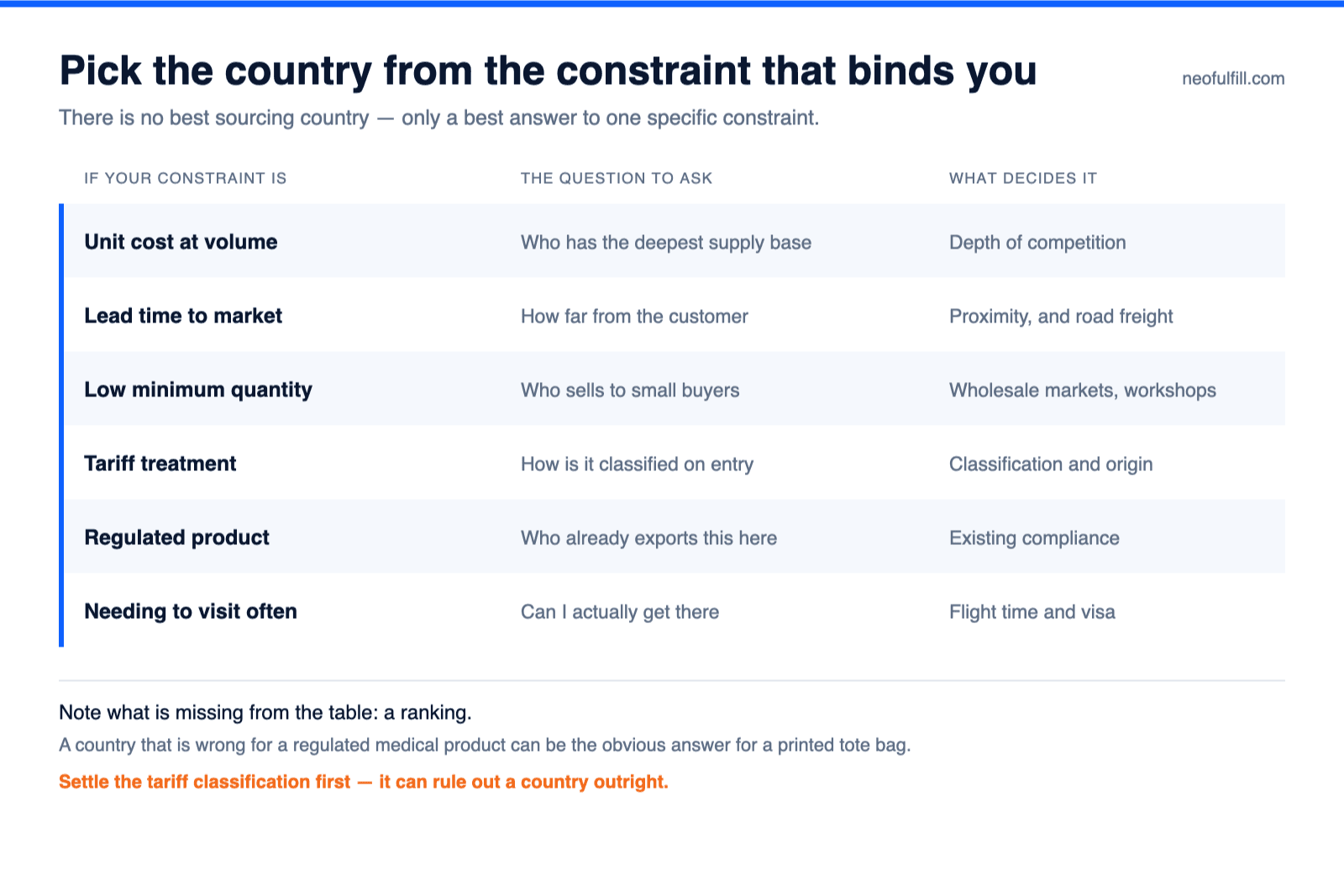
There is no best sourcing country, only a best answer to a specific constraint. Work out which one actually binds your project and the shortlist usually writes itself.
| If your binding constraint is | The question to ask | What usually decides it |
|---|---|---|
| Unit cost at volume | Who has the deepest supply base for this category | Depth of competition, not headline labour cost |
| Lead time to market | How far is the factory from the customer | Proximity, and whether you can ship by road |
| Low minimum quantity | Who sells to small buyers | Wholesale markets and smaller workshops |
| Tariff treatment | How is this product classified entering my market | Classification and origin, checked before you commit |
| Regulated product | Who already exports this to my market | Existing compliance, not a promise to obtain it |
| Needing to visit often | Can I actually get there | Flight time and visa, unglamorous and decisive |
Note what is absent from that table: a ranking. A country that is wrong for a regulated medical product can be the obvious answer for a printed tote bag.
When China is the wrong answer
We work in China, so take this as the section where our interest and your interest diverge. There are four cases where we would tell you to look elsewhere.
Your product's tariff treatment makes it uneconomic. If classification and origin put your goods in a position that erases the manufacturing saving, no amount of negotiating recovers it. This is a question to settle before sourcing, not after.
You need speed over cost, into Europe or North America. Nearer production shortens the lane and can allow road freight. If your model depends on reacting in weeks rather than months, proximity beats unit price and it is not close.
Your quantities are very small and will stay small. Below the point where a factory relationship pays for itself, you are paying coordination costs for a scale you do not have. Buying finished goods is often simply better.
The category has a stronger tradition elsewhere. Some products have a centre of gravity built over generations — in the fibre, the tanneries, the glassworks or the machining. Sourcing against that is possible and usually not worth it.
If any of those four describe you, we are not the right partner and we will say so on the first call rather than take a project we would do badly.
Where China is usually still the answer
One reason above all, and it is not the one people cite.
Depth. For most manufactured consumer goods the supply base is deep enough that you have alternatives — several factories that can make your product, components available locally, and tooling and finishing within a short drive. Depth is what gives you leverage, and it is what lets a project survive a supplier disappointing you.
Headline unit cost is the reason usually given and it is the less durable one. A supply base you can switch inside is worth more than a quote.
Sourcing from China: the process and costs sets out the nine steps, and China sourcing covers what we take on.
One agent per country, in most cases
An agent's value is local: who they know, what they can see with their own eyes, and whether they can be at the factory next week.
An agent covering several countries either has people in each — in which case ask who, by name, and where they live — or subcontracts, in which case you are paying a coordinator to manage a relationship you cannot see. The second is a layer added, not removed.
Two questions settle it quickly: who stands on the factory floor, and what does your inspection produce? A measurement sheet against an approved sample is evidence. A verdict without numbers is an opinion with an invoice attached.
The order to run this in
- Settle the classification and tariff treatment of your product in your market. Before anything else, because it can rule out a country outright.
- Decide which constraint binds you — cost, speed, minimum quantity or compliance. Only then shortlist countries.
- Appoint locally in the country you chose.
- Insist the specification is written so a stranger could judge a sample against it. Without that, the rest is unenforceable.
Most sourcing projects that go wrong went wrong at step one or step four, and were blamed on the factory.
Common questions
What does an international sourcing agent do?
How do I choose which country to source from?
Is China still the best country for sourcing?
Should I use one agent per country or one agent for everything?
What is the difference between a sourcing agent and a trading company?
Can one agent handle several countries?
Decided China is the right country?
Send the product and the quantity you need. We check certifications, reputation and reviews from the factory's own customers, and where the project warrants it we go to the factory.